
Welcome to September’s newsletter… 12 days late! It has been busy; my 50th birthday, school heading back (I now have a year 5er) and the ultimate sporting weekend in Jersey doing a SwimRun (bonkers race – running in a wetsuit and swimming in your trainers – it is an odd look), a Half marathon and then getting to watch the SuperTri series final. As much as I adore triathlon and have raced it for the last 22 years I have to admit it is rarely exciting to watch. SuperTri though have made it a spectator sport and Jersey definitely came out for it; partly cause it was awesome and partly to support Siena Stephens who is Jersey born and breed and who had travelled back from Loughborough Uni to race. She did the island so proud.
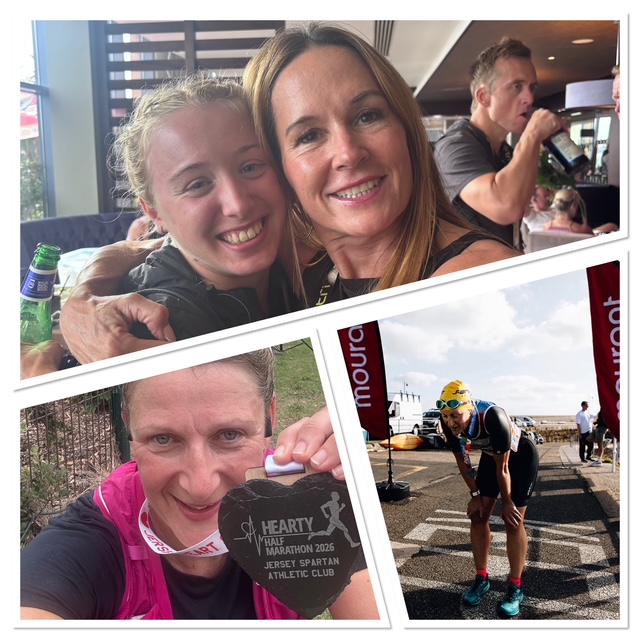
SuperTri is definitely a business and those racing are pitched like commodities and entertainers rather than the elite athletes they are but it was done awesomely and the athletes benefit too; the winners won £100,000 and over 60% of the field took home prize money. The format is swim, cycle 4 laps, run 2 laps x 3. If you are 90 seconds behind the leader at the start of a lap you are eliminated. It is harsh – more than half of the female wave got eliminated at some point – but it is also exhilarating to watch. The adrenaline meant I felt utterly exhausted after watching each race – I have no idea how Annie (my Be Braver co-host) who was commentating stayed on top of it all – but of course she did! So if you get a chance to watch one live – or tune in on YouTube – it is well worth your attention.
You don’t have to feel good to do good…
There are two phrases I repeat a lot that don’t always seem logical coming from a sport psych. The first… You don’t have to feel good to do good. Of course it is lovely to feel good; we want a body buzzing with energy, we want to feel mentally and physically amped up for performance and we’d love a clear mind which lets us get into the feeling of flow once we are in competition. The reality is though that flow doesn’t show up on demand, that we have all had great days in sport when we assumed that we wouldn’t and that the growth that comes from feeling rubbish and still working hard is often the bit of which we feel most proud. So next time you don’t feel great – try to catch your brain before it goes to ‘I can’t’ or ‘it’s not my day’ or ‘bad legs today’ and focus on all of the inputs you will follow to perform well. You might not perform at your best – but if you have done the right stuff, at the right time, using the right behaviours you still get to feel proud at the end.
Stop trying to win…
The second phrase must sound really odd coming from a Sport Psych is especially true for VIP athletes. VIP stands for Very Intelligent Perfectionist and VIPs not only want to do things perfectly (which is impossible) they often attach their main identity (runner / footballer / hockey player) to the outcome of the competition. So if they don’t do as well as they wanted they don’t just see that it was a bad day, they see themselves as a failure – this feels threatening. Threat comes from needing to ‘win’ because anything other than ‘winning’ is losing; and that feels terrifying to a VIP. Remove the goal of ‘winning’ and you stop the threat. This ensures the logical part of the brain stays in charge, you maintain good body shape, you minimise negative head chatter and you don’t get a body flooded with performance harming cortisol. So no threat = much better performance. How to shift away from threat? Again it is a focus on inputs; which ten things could you do in your next competition which will allow you to focus on the tasks that make you excellent? Those are the metrics to measure yourself (and your sport) by.
Neurodivergent traits
The feedback from ADHD in Sport has been so positive which is lovely but I am also very conscious that writing long form texts for those struggling with focus and attention is not particularly helpful. I’ve also had requests for an AuDHD in Sport book because so many athletes (especially female athletes) are receiving this diagnosis at the moment.
So… I am working on something… something not diagnosis based but more focused on traits and behaviours that might show up for you if you are neurodivergent. More to come on this once I’m allowed to talk about it but before then I need your help. I have put together a survey to understand which of the traits and behaviours I might cover have the biggest impact; both positive and negative on those who are neurodivergent. And then I’d love to chat to some of those who complete it to understand more and to see what tools and tactics seem to work effectively and what would be most helpful.
So if you are neurodivergent (ASD, ADHD, AuDHD, Dyslexic, Dyspraxic, Dyscalculic or have Tourette’s) – or don’t have a diagnosis but suspect you would get one if you went for assessment please could you fill it in for me: https://forms.gle/1GncCj51dqjsfakU9
ADHD and Hormones
Finally, have been researching a lot lately for some of the female ADHD athletes I get to work with and found some good tools to recommend.
Books on ADHD and Hormones:
Female Hormones and ADHD by Skoglund and Kallner. Available here:
Women and ADHD: From Puberty to Menopause and Beyond by Cubbin and Johnson. Available here.
A webinar:
Female Hormones and ADHD with guest speaker Dr Lotta Borg Skoglund — The Neurodiversity Practice
An App:
Rithim – ADHD and Cycle forecasting
An in-person event:
The science of AuDHD by Professor James Brown gives a Seed Talk in Soho, London on September 22nd (also streamed online) The Science of AuDHD: Understanding how ADHD & Autism intersect Tickets, Tuesday, September 22 • 7 PM – 9:30 PM | Eventbrite If you are going to this I’ll be there and would love to say hello.
Have a brilliant rest of September.
Recent Comments