
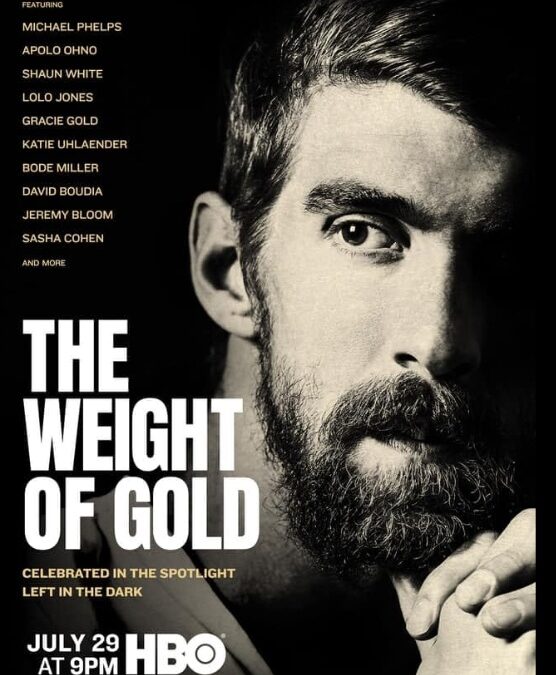
Over the years I’ve been told The Weight of Gold is an excellent watch. It is an HBO production so I’d never been able to access it in the UK but now you can watch on Amazon Prime.
In short: A really interesting reflection on the mental health aspects of performing in the Olympics hosted by Michael Phelps incorporating the stories of a number of athletes in their own words. In the words of one of the athletes: “Being an Olympian is advertised as an amazing thing but they leave out all the side effects. These might be an eating disorder, suicidal ideation, depression, anxiety, a disconnect from the real world.”
It is very specific to the Olympics, and to US athletes but there are lots of lessons to be taken from it, especially for Coaches, Performance Lifestyle staff, Sport Psychologists and Clinical Psychologists working in sport. The mental health elements discussed all seem amplified because they are sports where the Olympics is the biggest stage and where there are few opportunities for wealth and validation outside of one race every four years. They also seem amplified because support and funding for athletes in the USA is very different. I would hope that things would not be so bad for UK based professional athletes but many of the issues will persist.
Despite those specificity there are a number of issues that are likely to show up for anyone who takes their sport seriously and has a mono-sporting identity (when ‘what they do is who they are’). The documentary touches on:
- The childhood differences that come from training in sport from a young age: “None of us have normal childhoods.” “Focus got very narrow and intense very quickly which has ramifications later in life.” “Everything that wasn’t sport was an obstacle.” “I didn’t develop outside interests – it was a compulsion.”
- Being driven by fear of failure: “The difference between great and good is that the greats do things when they don’t want to.” “I was inadequate. I was the hardest worker – because of my obsession with not being good enough.”
- The intensity of training for one race or event: “It is all you have done for ten years and the next 40 seconds will dictate if you have a gold or not. And it is all over.” “Not only are you having all these feelings but you are having them while the whole world is watching you.. and there is a soundtrack of disappointment.”
- Depression: Even if you win says Phelps, very quickly the excitement dulls down and then you feel very lost. He suggests more than 80% of athletes have some kind of post-Olympic depression. He highlights that anyone can get this but the hyper focus of athletes means that there is no route for the energy and attention and so may struggle more. He discusses how, even if you become one of the success stories it still comes with a catch and going back to the grind for another 4 years doesn’t sustain. “The question I needed to answer,” he says is, “who was I?”
- Financials: The financial impact is really closely linked to performance (you can’t perform if you can’t feed yourself or get to training) and in the US more important because of the need for health insurance.
- Suicide: All the athletes talk about suicidal ideation. And the documentary discusses the Olympians who ended their lives. This section is incredibly hard to watch. how he contemplated suicide and was supported back into life. Highlights the support that is required to recover.
- Why so hard to talk about mental health issues as an elite athlete: “We can make ourselves unbeatable if we just work harder. And the things that make us get to the top means we feel we can’t be vulnerable. You can’t even admit it is an issue. You need to show the world you are strong.”
- Retirement: Phelps states how unusual it is in life to retire in your 20s or 30s and so we should be better at helping athletes deal with this.
The solutions… Not many are discussed but those that are focus on support and ease of access to that support. They suggest we need not to think about sport psychology as helping someone be able to perform well but also to be able to cope afterwards. I would hope many of us already do this. There is also a suggestion that the professional athletes who do talk about their mental health struggles are normalising and opening doors for those coming after them to be better able to ask for help.
Highly recommended to watch if you want to widen your understanding of mental health in sport. Links here
Recent Comments