
In this lesson we will learn about the brain, how it tends to behave in sporting situations and where ADHD traits can impact in sport.
Why we need to understand the key functions of the brain
Do your athletes ever tell you they wish they could take their brain out and just play? Do they want to be able to focus for longer, stay calm in key moments, show up without nerves, be able to concentrate on your instructions without 100 other messages ping ponging into their brain?
More bluntly athletes might come to see me and tell me their brain is broken, they have a rubbish mindset or all their problems are caused by their head. Often they will have picked this up from a parent or coach. If you, as a coach can help them understand why they might be struggling more with their mental approach then you help stop them going down such a negative path of self-flagellation and instead have more tools (which you’ll learn in lessons 6 and 7) to tackle their concerns effectively.
This means it is super important that you understand the 3 key functions of the brain and why one element of them (the threat system) can have such a negative impact on our sporting performance.
The habit function
The first function of the brain to be aware of is the habit function. This has all the skills and knowledge an athlete will have developed from practice. It means they can make all the micro decisions they need without fatiguing their brain and still allows them to do all the basics even when their brain has been hijacked by the threat function.
We can think of our habit function like a storage unit; holding all our values, skills, strengths and techniques, working away in the background using all the stored information to make automatic decisions based on pre-programmed thoughts and behaviours developed over years of practice.
The habit function is particularly important for an athlete with ADHD as their brain knows WHAT to do, just doesn’t always DO it. Once something is habitual the process of one part of your brain telling the other part what to do becomes redundant and your body just acts automatically. Additionally, having your habits work away in the background, making thousands of unconscious decisions for you (35,000 a day according to research) means you have more headspace left over for the decisions and actions which do require more strategy or tactical knowledge.
In takes on average 66 days to build a new habit. So the drills you give your athletes may feel repetitive and they may complain but they are essential for developing robust technique that won’t fall apart under pressure.
The logical decision function
When something is too complex, happens too irregularly to become a habit, or if the athlete is still learning a skill or routine, then their logical decision function comes into play. It is made up of the networks in the brain that help an athlete make great choices, specifically those based in the pre-frontal cortex (involved in decision making, executive functioning, behaviours and planning – but also the area where ADHD creates deficits) and hippocampus (where all your knowledge, learning and experiences are stored). When a choice needs to be made your brain searches through the knowledge and evidence you have on offer with the aim of figuring out the best option to take and tells your body how to do it. It will be where their experience and sporting intelligence makes the difference to their performance.
It they just had the logic and habit functions your athlete would always perform to the level of their potential, the practice they had invested and the fitness they have developed. But we also have another function, a safety function.
Safety function
As the brain is designed to ensure survival it has developed four incredible ways to do so:
- Helping an athlete predict possible outcomes – this is good for boosting their dopamine (our reward chemical that is thought to be lower in those with ADHD) but can also cause worries in those who over-predict and ruminate about the negatives.
- Body budgeting so the athlete’s body works efficiently – this can be tricky in athlete’s with the hyperactive type of ADHD or who hyperfocus meaning they work too intensely on a sporting problem and put their body budget out of whack.
- Prioritizing negative memories – this is to keep the athlete remembering the things that could harm them so they can stay safe. Helpful for physical safety – unhelpful for high performance. Neuroscientists now believe that for every negative thought you have about yourself, you require five positive things to stay in a good place.
- Activating a threat system in emergencies to help us escape anything that could harm us. Originally designed for physical threats but now often over-activated for psychological or physiological threats too.
All these together aim to keep an athlete as comfortable as possible and ensure their survival. When they combine they push the athlete towards their comfort zone (for safety) which can prevent them stretching themselves or try new things, limiting their ability to perform at a high level. The really important area for you to understand as a coach is the threat system.
Threat system
The job of the threat system is survival. This means it is constantly scanning for things that could physically, psychologically or physiologically harm.
There are three groups of threats:
- Physical threats – might the athlete get hurt – they should be conscious and listening to these type of threats.
- Psychological threats – might my sense of self, identity or confidence get hurt. These are usually unhelpful threats coming from our own views or worries about what others might say or think.
- Physiological threats – does something inside my body hurt? These might be niggles, injuries or organs having to work really hard. These should be evaluated on a case by case basis being curious about the cause of the threat.
Sometimes the threat system over predicts (especially around psychological risks) and ‘triggers’ causing an athlete to feel under threat and keen to hide away in their comfort zone. Most of the ‘threats’ they anticipate in performance environments are psychological ones like not being good enough, failing or being judged. These will often link to outcomes (scores, competition placings judgement from others) what that outcome might say about them as a person. If they feel what they do is who they are (I’m academic, I’m sporty or I’m a footballer) then the potential of failing feels extra scary to their threat system (because if they fail they feel a failure) which then triggers them, making them behave emotionally and irrationally. Their habit function will still work but their logic function shuts down so they can’t make good decisions and they lose their sense of perspective.
When your threat system triggers three elements kick into action which we can think of as:
- Cognitive
- Physiological
- Behavioural
We will explore each now.
Cognitive impact
When the threat system has been triggered an athlete’s head chatter turns negative and they might start to notice unhelpful messages trying talk them out of reaching towards their goals. This might show up as procrastinating, pre-making excuses for why they might not do well, self-sabotaging by playing on their phone, not practicing or preparing properly or signing up to lots of things so they can justify not doing well on the thing they actually care about. These all make it harder to do well.
Some common negative thoughts athletes report thinking:
- I’m useless
- This is embarrassing
- I’ll never be able to do this
- I should have quit – they are all laughing at me
- I’m too slow
- I’m rubbish
- I’m never be good enough.
Physiological responses
When the brain has identified a threat it will release two chemicals: adrenaline and cortisol. These can have a big impact on the body.
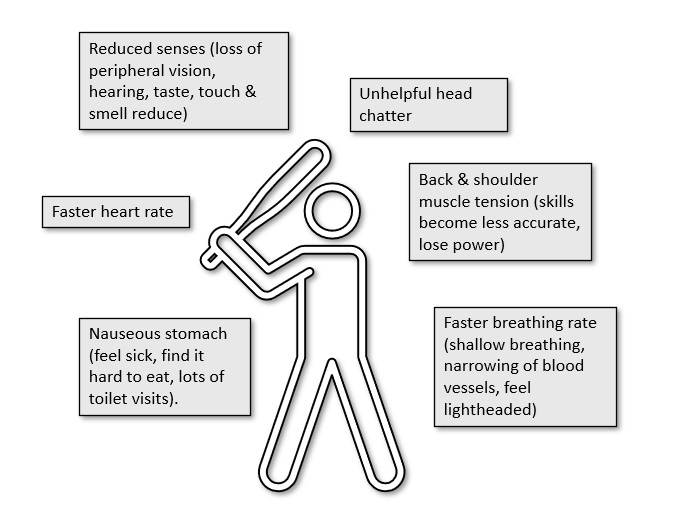
Many of these can make it hard to perform well. Many athletes report tummy aches and feeling sick before competitions. Some will talk about the racing heart rate or breathing too fast. In sports where a piece of equipment is used to hit a ball (tennis, golf, snooker etc) the back and shoulder tension means that they are unlikely to hit the ball in the way they planned to causing issues and lost points.
The big issue is that our threat system doesn’t just scan the external world for potential risks, it also scans internally within our bodies. When our heart and breathing rates are elevated (even though it was the threat system causing this to happen) then the safety function notices and releases more adrenaline and cortisol to flood the body. It becomes a very unhelpful feedback loop.
Behavioural responses
The chemicals that impact your body (the adrenaline and cortisol), preparing you to physically deal with the threat tend to trigger one of four behavioural response:
- Fight (most athletes don’t actually fight – they just get super chatty)
- Flight (these athletes will avoid every possible opportunity to be tested so may quit sports once they get good at them)
- Freeze (these people will go very quiet and want to be left alone)
- Fawn (these people will often have been treated badly in the past so try to people please or placate others in order to stay safe).
Additionally, you’ll often see an athlete’s body shape change; they get smaller as if they are trying to take up less space and not be noticed. In some sports Like Rugby or Gymnastics this can have a negative impact on their movement patterns and performance.
Threat system triggers
Threat system triggers can come externally and internally. The internal buckets of stress will those physiological, psychology and social ones.
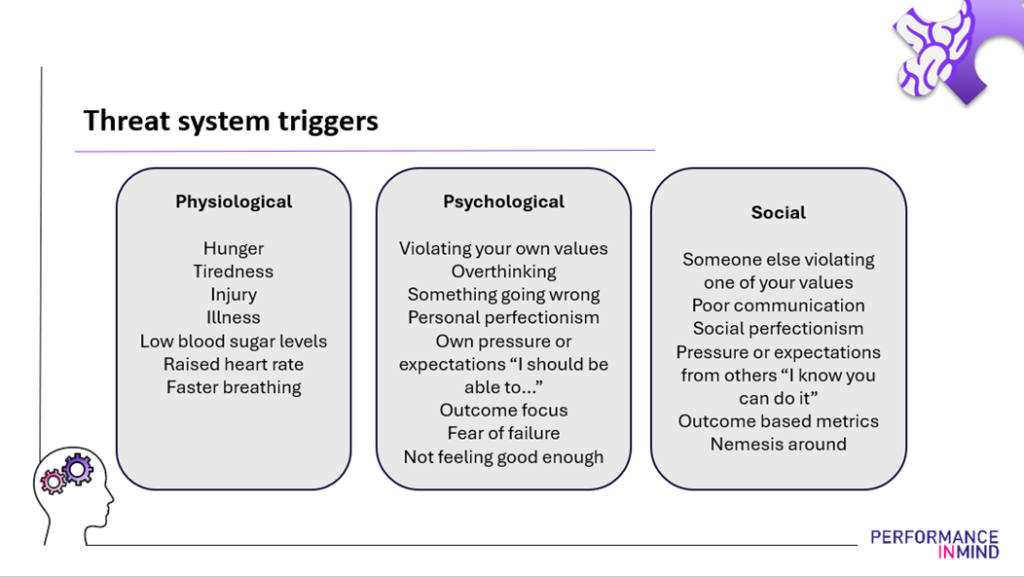
External factors can also put our threat system on edge – creating a cumulative effect. Which ones do you see in yourself…
- Lack of food or drink you like
- Kit breaking or wearing out
- A difficult course or match environment
- Weather conditions
- Poor communications
- Daily or life stressors you don’t feel able to handle
- Ambiguity of information or status
- Sensory overwhelm.
How ADHD can amplify the triggers and responses of the threat system
ADHD can make an athlete over sensitive to threats. Again, there are lots of potential reasons for this:
- Personality traits (such as perfectionism which is very common in ADHD)
- Unfairness (which shows up a lot as justice is a common value of important for those with ADHD)
- High intelligence (it is thought those with ADHD have, on average, higher intelligence than the neurotypical population, but it does mean their brain becomes very good at predicting the worst)
- External pressures (from having done well in the past or having messed up in the past – remember that a child with ADHD will have received 20,000 pieces of negative feedback by the age of 10)
- Mono-identity (sport being their everything and giving them all of their self-worth, especially is they are regularly told off in school)
- Previous experiences (like having been bullied or publicly criticised)
- Possible future experiences (knowing that people around them are judgemental).
- Rejection Sensitivity (filtering feedback or comments negatively)
In lesson 5 we will look at some tools to help your athlete soothe and stay in control of their threat system so they can perform better in your sessions and competitions.

Recent Comments