
In this lesson we will learn…
- The Cycle of benefits
- Cognitive Benefits
- Behavioural benefits
- Impact on motor skills
- Emotional and social benefits
- The ADHD exercise prescription
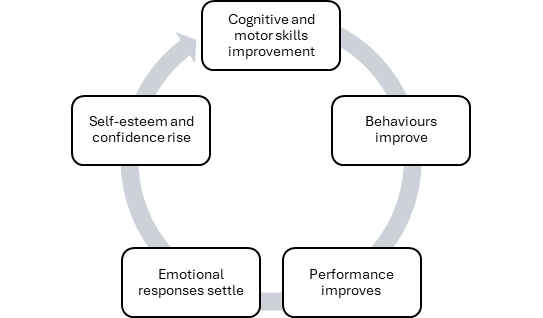
The cycle of benefits
As a coach you’ll know about many of the benefits that exercise and sport can bring including:
- Reducing cognitive deficits – improving concentration, executive functioning and motor skills
- Helping control inappropriate behaviours
- Acting as an anti-depressant with anti-anxiety properties
- Providing a place to get positive feedback, build friendships and grow confidence.
As many of the benefits of exercise are around areas impacted by ADHD (cognitive, behavioural and mood) it makes sense that exercise can be particularly effective in helping those with ADHD manage some of their symptoms. It is a really safe method of symptom relief with benefits far beyond the ADHD cognitive symptom reduction.
VIDEO: Everyone benefits from exercise. The simple explanation of why is that there is a positive influence of exercise on the structure, function, and growth of the brain. The act of movement facilitates changes within the brain; in neurotransmitter levels, enhanced cerebral capillary growth and blood flow to the brain, promotion of neurogenesis (the process of creating new neurons in the brain) and growth in brain tissue volume. These are all changes that can enhance our cognitive function. It is thought that those with the greatest deficits in cognitive function will benefit the most from exercise, so it will be especially beneficial to those with ADHD.
On the emotional side we can consider the role of Serotonin and Endorphins.
- Serotonin = the neurotransmitter that regulates mood, sleep and your digestive system.
- Endorphins = neurotransmitters released when you feel pain or stress and are designed to reduce those feelings; imagine them to be like a natural pain killer.
It is assumed that exercise provides an increase in both serotonin and endorphins so that your mood improves and you flood your body with a natural painkiller improving your sense of wellbeing.
More widely on the social side it is thought that the more exercise you do the more your sporting competence levels improve and this can connect you to peers and improve your relationships with them. Additionally, the physical health outcomes of exercise; improved fitness, a strong body, relaxation and coping mechanisms means that you not only feel better but also engage in other positive health behaviours like having a good health routine, sleeping well and eating healthier foods.
Cognitive benefits
Exercise and physical activity can improve lots of cognitive functions – these are the different skills that involve learning and problem-solving.
Here are 12 different cognitive functions that exercise can improve: (can I put these as boxes to match?)
| Function | Description |
| Attention | The ability to focus on the right things at the right time. |
| Set shifting | The ability to move between different tasks. |
| Cognitive flexibility | The ability to adapt our behaviour and ways we think depending on the environment we are in. |
| Planning | Being able to solve problems. |
| Information processing | The way we gather, manipulate, store and retrieve information within the brain. |
| Reducing impulsivity | Not acting before considering the consequences. |
| Response inhibition | Being able to prevent yourself doing behaviours or actions that might harm your long-term goals. |
| Improved organisation | Put in place the systems and logistics to get what we want done. |
| Improved working memory | Ability to hold onto the information we need for the current task we are on. |
| Improved cognitive control | The thought processes which allow us to make the right choices for the goals we have. |
| Faster processing speed | How fast your brain can take in, assess and choose what to do with new information. |
| Vigilance | Being able to keep watch for danger. |
Behavioural benefits
The behaviour benefits of exercise on ADHD in children (there is far less research into adults) find that immediately after movement:
- Attention span increases
- Impulse control improves
- Classroom disruptions halve.
Longer term, low heart rate exercise is found to:
- Lower levels of anxiety
- Reduced hyperactivity
- See fewer inappropriate emotions show up
- Limit daydreaming.
VIDEO: Why does exercise improve inattentive, impulsive, and hyperactive behaviours?
We think it is because when tasks are boring or monotonous (remember ADHD brains are motivated by interest not importance), novel and active tasks (like exercise breaks) dissipate poor behaviour and improve performance.
If you want to improve behaviour with a group of athletes or participants it is essential that (unless there are putting themselves or others in danger) you don’t limit their movement, making them sit out for poor behaviours – it will only make behaviours worse. They need to move to be able to improve their behaviours and calm themselves down. Making them sit out to watch will create a volcano effect and an unhelpful eruption!
Impact on motor skills
A specific symptom of ADHD can be diminished motor skill proficiency – tricky for those wishing to excel in a sporting environment. A number of studies suggest that exercise can benefit poor motor skill proficiency.
| Skill | Definition | Study |
| Overarching motor skills | Specific movements within the body where the muscles, nervous system and brain all work together to allow us to do a certain task like walking, running, or riding a bike. | Researchers who set boys with ADHD 9 x 30 minute HIIT sessions over a three week period found that, as well as physical fitness, motor skills (including dexterity and ball skills) and scores focused on self-esteem and friends. |
| Locomotor skills | The skills that help us move from one place to another like walking, marching, running, jumping, hopping, galloping, skipping or climbing. | A study over 10 weeks of 45 minutes of moderate-to-vigorous exercise three times per week found improved locomotor skills. |
| Dexterity | Fine motor skills to do small, precise movements and valuable in sports that involve hand eye co-ordination. | In a study of boys with ADHD, exercise appears to improve manual dexterity. |
Emotional and social benefits
There are two routes through which exercise can help develop emotional improvements:
- The exercise itself making brain changes which trigger fewer negative emotional responses
- The cognitive and behavioural responses to exercise mean that those with ADHD have fewer social issues, less moments where they feel they have failed and not feeling they are being told off or nagged. This can boost self-esteem and social functions.
There are lots of studies on exercise for helping with unhelpful ADHD symptoms. Here are some that might be of interest:
- Stress: Low heart rate exercise (like Yoga or Tai Chi) can help those with ADHD cope better with stressful situations, be more mentally flexible (so able to cope with changing situations or environments) and place attention in the right places at the right time. One study reported improved anxiety and conduct as well as less hyperactivity, inappropriate emotions and daydreaming in children with ADHD following tai chi sessions.
- Anxiety: Those with ADHD have a higher-than-average risk of anxiety. Exercise has been found to lower the risk of anxiety and depression in everyone but a study looking at those with and without ADHD found children with ADHD who regularly participated in sports showed fewer anxiety-related symptoms compared to those participating less.
- Physical ailments: When our threat system is triggered, adrenaline and cortisol flood our body and this physical manifestation of our worries is called somatic anxiety. The first place we tend to notice its impact is in our stomach, causing tummy ache. Exercise has been found to reduce these somatic anxiety symptoms. It may be related to exercise lowering levels of stress in general or it may be that exercise is working well as a coping mechanism.
- Positive mood: A study looking at ADHD adults using exercise found that almost all of them proactively used exercise to lift their mood. They reported that being physically active increased mental clarity and attention and that two thirds said when they were less physically active their mood dropped and they felt their mental health suffered.
- Confidence: A third of ADHD participants in a study on the value of exercise reported that seeing progress at the gym helped them feel they had increased their competence, confidence, and self-esteem.
- Motivation: A 20-minute cycling activity in adult men with ADHD symptoms found their motivation and energy increased and their feelings of confusion, depression, and fatigue decreased.
- Sense of belonging: A core human need is to feel that we belong. Exercising with others can serve as a way to facilitate positive social and peer interactions. These can be lacking in those with ADHD if they have spent a significant amount of time being ‘told off’ or shamed for disruptive behaviours. Exercising has been found to improve social skills and enjoyment of being able to work well with others.
The ADHD exercise prescription
If you are coaching in a sport then you’ll be the expert on what physical training to prescribe for the specific sport. The better it matches the competition requirements the more effective it will be. However, if you are working in a more participatory level or within an education setting then some of the things to think about for your participants with ADHD will be…
- 10 min energy boosters for immediate changes to reduce hyperactivity, improve attention and lower stress.
- Regular cardio exercise (that makes you out of breath and sweaty) between 20-30 minutes of at least five times a week to improve cognitive functions and motivation, curb some disruptive behaviours, lower impulsivity, emotional stressors, intrusive and worrying thoughts and reduces confusion and fatigue). These benefits are often found to extend beyond the day the exercise took place.
- Aim to take part in at least three different physical activities to significantly reduce symptoms of anxiety or depression.
- Low heart rate exercise (like stretching or yoga) can help with longer term anxiety reduction or hyperactivity.
- Amp up this prescription any time significant brain development is taking place.

Recent Comments